Korean Armistice Agreement
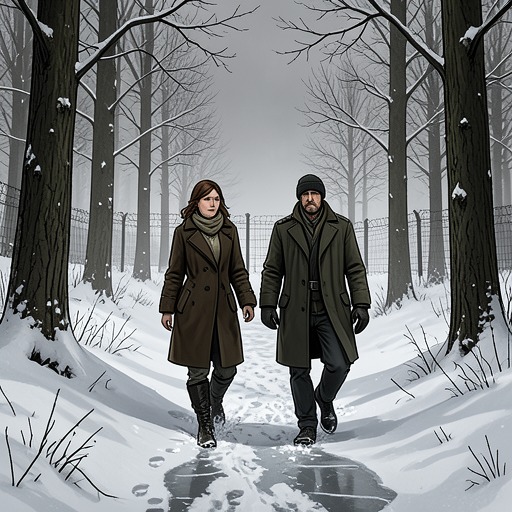
Winter in SokchoThe Korean Armistice Agreement is presented as a halt to the Korean War that fixed a frontier but did not resolve the conflict. Its significance in the novel lies in that unfinished settlement: the border can be viewed, mapped, and visited, yet the narrator describes the peninsula as still living in the war’s suspended aftermath.
Historical Settlement and Terms
During a visit to the Korean border observation area, Yan Kerrand stops at a museum display and asks the narrator to translate its account of the conflict. The exhibit dates the war’s beginning to 1950, describes North Korea as supported by the Soviets and China and South Korea by the United States and the United Nations, and gives 27 July 1953 as the date the armistice was signed. It says the frontier was created along the 38th parallel, within a no man’s land four kilometres wide and 238 kilometres long, and identifies it as the world’s most heavily militarized border.
The display also records the immense human cost: between two and four million civilian and military deaths over the three years of fighting. Its final fact changes the meaning of the word armistice: no peace treaty was ever signed. The agreement ended active fighting without bringing the two Koreas to a formal peace, leaving the border as the material form of an unresolved conflict.
The Agreement Encountered at the Border
The museum’s account is embedded in a tightly controlled visit. At a checkpoint, a young soldier makes the narrator and Yan Kerrand fill out forms while a loudspeaker repeats prohibitions against photography, filming, leaving the marked path, speaking loudly, or laughing. An armed convoy initially escorts them across the grey, reed-filled no man’s land; after it turns away, they continue alone. The restrictions make the frontier more than a line on a display: it regulates where visitors may go and what they may do.
At the observation point, visitors can pay five hundred won to look toward North Korea through binoculars. The narrator inserts a coin, but fog obscures the view between the ocean on one side and mountains on the other. The paid act of looking promises access to the divided peninsula and delivers almost none. The landscape’s visibility is limited even as the border is made available for organized observation.
A Border in Daily Life
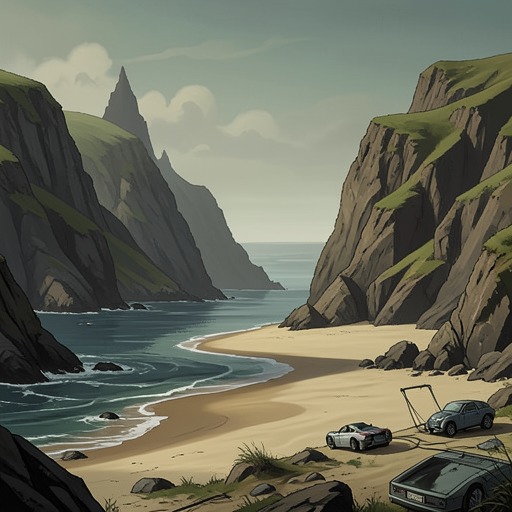
The museum is one part of a landscape already marked by the division. On the beach near Sokcho, electrified barbed wire scars the coast; the border with North Korea is less than sixty kilometres away. The narrator’s account links the frontier’s historical origin to the present through these ordinary surroundings and through the rules and installations that shape a visit to it.
The narrator also contrasts the display’s historical summary with the lived sense of suspended danger. She tells Yan Kerrand that the beaches may carry scars from past wars elsewhere, but that these beaches are still waiting for the end of a war people have nearly stopped believing is real. Hotels and neon signs coexist with her image of life on a knife-edge, in a winter that does not end. This is her interpretation of the armistice’s legacy, not a claim that the fighting continues in the same form: the agreement has left a condition of limbo rather than a concluded peace.
That danger is not only symbolic. The narrator recalls that the previous summer a tourist from Seoul was shot by a North Korean soldier while swimming, after unknowingly crossing the border. The incident shows how a boundary established in the aftermath of the war can still have lethal consequences, even for someone who does not realize she has crossed it.
Narrative Significance
The agreement reaches the reader through two different kinds of testimony: the museum’s concise chronology and the narrator’s response to the landscape around it. The display supplies dates, military alignments, dimensions, and casualty figures; the checkpoint, fogged lookout, wire along the beach, and shooting give those facts a present-tense weight. Yan Kerrand listens as the narrator translates the museum text, while she connects its official history to the feeling of living beside a war that has not been formally settled.
The resulting contrast is central to the event’s role in the narrative. The armistice is a historical document that ended combat, but its uncompleted political settlement remains legible in the border’s fences, prohibitions, observation equipment, and risks. The landscape is at once a destination for visitors and a continuing political space for those who live near it.